
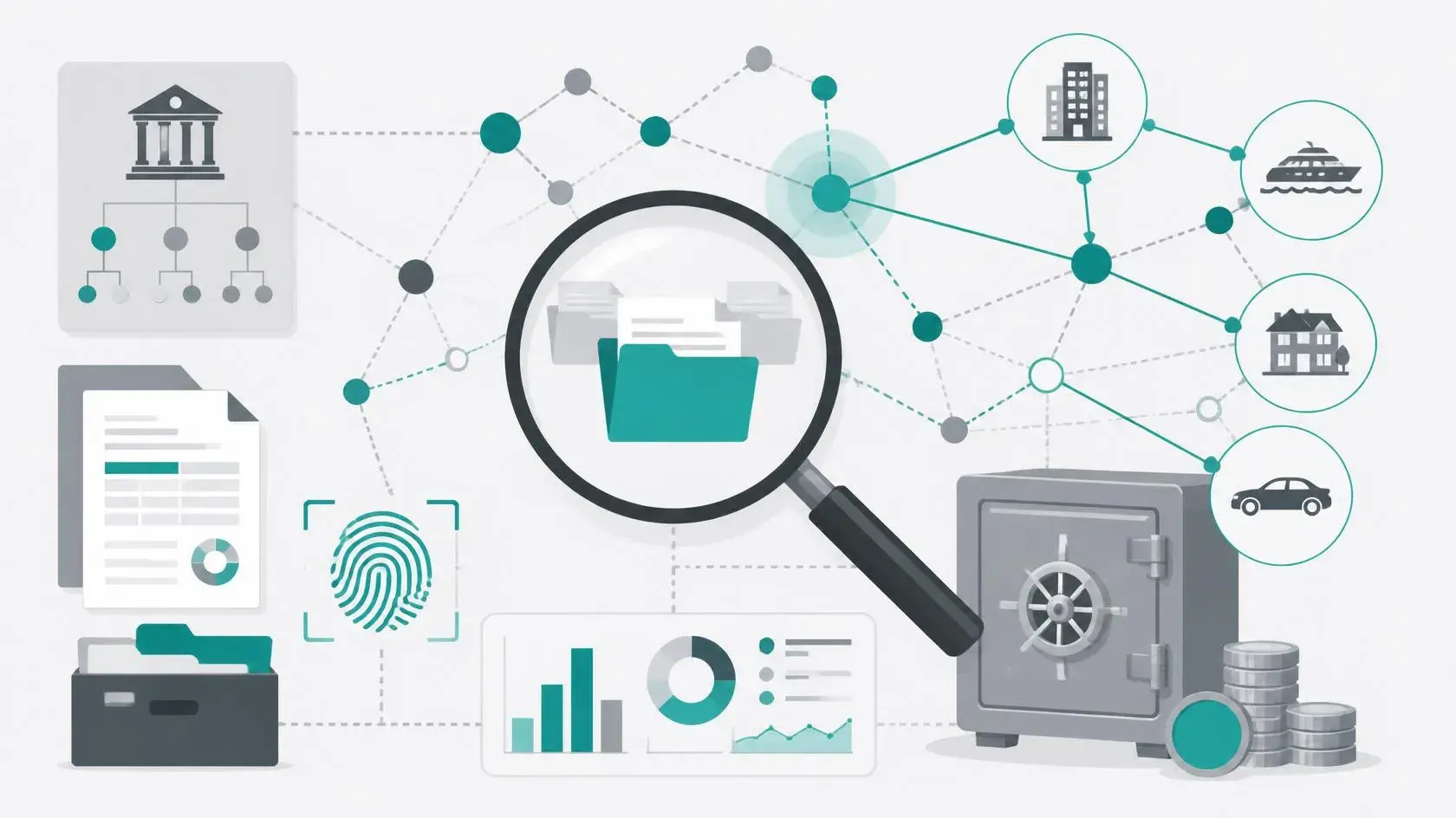
Introduction: Why Asset Concealment is More Common Than Businesses Realise
Asset concealment or the deliberate hiding or obscuring of ownership, control, or value of assets is far more widespread than most businesses assume. While often associated with major fraud or corruption cases, it frequently exists in subtle, legally grey, and sophisticated forms embedded within everyday corporate structures. The real risk for businesses lies in underestimating how easily concealment can occur within routine operations, governance gaps, or complex ownership arrangements.
What is Hidden Asset Discovery?
Hidden Asset Discovery is the process of identifying, tracing, and proving the existence of assets that have been deliberately concealed or not disclosed by an individual or organization. It combines investigative techniques, financial analysis, and legal tools to uncover money, property, or investments intentionally kept out of sight.
Asset Tracing vs Asset Recovery: Understanding the Difference
Asset tracing and asset recovery are related but distinct steps. Asset tracing is the investigative phase in which experts track where assets are by analysing records and following fund movements across accounts or entities. Asset recovery comes afterward and involves legal action to freeze, seize, or retrieve those assets. In simple terms, tracing finds the money, while recovery gets it back.
When is Hidden Asset Discovery Required?
Hidden asset discovery becomes necessary whenever there is doubt about whether financial information has been fully disclosed. It is critical in:
- Fraud and financial crime investigations
- Due diligence for mergers, partnerships, or investments
- Debt recovery and bankruptcy proceedings
In such situations, understanding the true financial position or ownership structure is essential for legal, commercial, and compliance purposes.
Common Methods Used to Conceal Assets
Individuals seeking to hide or obscure their wealth often employ a variety of techniques designed to make ownership difficult to trace or verify. Some of the most frequently used methods include:
Offshore Accounts and Shell Companies in Secrecy Jurisdictions
Offshore accounts and shell companies are often used together to create financial anonymity. Secrecy jurisdictions (commonly called tax havens) offer low taxes and minimal disclosure requirements, allowing individuals to hide financial ownership. Typically, a shell company is set up in such a jurisdiction and used to hold assets or operate bank accounts. This layered structure distances assets from their true owners. While these arrangements may serve legitimate purposes, they are also widely linked to misuse, including tax evasion and money laundering.
Property and Real Estate Held Through Nominees
Nominee ownership involves registering property under another person or entity while the real owner retains control and benefits. The nominee appears in official records, creating a layer of separation. These structures are often combined with companies or trusts, making it difficult to trace ownership. While sometimes used for administrative convenience, they are frequently associated with asset concealment, tax avoidance, or shielding wealth from legal claims.
Cryptocurrency and Digital Asset Concealment
Cryptocurrencies provide unique opportunities for concealment due to their decentralized and pseudonymous nature. Assets can be stored in private digital wallets, transferred globally, and held outside traditional financial systems. Common concealment techniques include:
- Using hardware or non-custodial wallets
- Transacting via privacy-focused cryptocurrencies
- Employing mixing or tumbling services
- Distributing funds across multiple wallets
This makes the detection difficult and is commonly associated with fraud or laundering schemes.
Undervalued Transactions and Related-Party Transfers
In undervalued transactions, assets are transferred below market value to shift wealth while appearing legitimate. Related-party transfers involve moving assets between connected individuals or entities without proper disclosure or on non-commercial terms. Both methods can misrepresent financial positions, allowing individuals to retain indirect control while distancing themselves from ownership.
Business Interests Held Through Proxies
Proxy ownership occurs when business interests are registered under another individual or entity while the real owner exercises control behind the scenes. Proxies may include associates, employees, or companies. These structures are often layered with shell entities or nominee arrangements to further obscure ownership, making detection challenging for regulators and investigators.
How Investigators Trace Hidden Assets: Tools and Techniques
Tracing concealed assets involves a structured approach using multiple tools and methods:
Open-Source Intelligence (OSINT) and Public Record Mining:
OSINT involves collecting publicly available information from sources such as media, websites, and social platforms. When combined with public records like company filings or property registries, it helps uncover links between individuals, entities, and assets. Individually minor data points can collectively reveal patterns of concealed ownership.
Corporate Registry and Beneficial Ownership Analysis:
This technique focuses on identifying the real individuals behind companies by analysing incorporation records, directors, and shareholders. Beneficial ownership data helps trace control beyond legal structures, exposing the individuals who ultimately benefit from assets.
Financial Transaction Forensics and Bank Record Analysis
Investigators examine transaction histories, wire transfers, and payment records to identify suspicious activity. Patterns such as unexplained transfers or inconsistencies between income and spending often indicate concealed assets. Reconstructing these trails helps trace funds across accounts and jurisdictions.
Property and Land Registry Searches
Property records provide reliable evidence of ownership and transaction history. By examining land registries and title deeds, investigators can identify assets held through nominees or companies and detect suspicious transfers or undervaluation.
Discreet Field Enquiries and Source Network Intelligence
On-the-ground investigations involve gathering insights from local contacts, employees, or associates. Lifestyle observations such as properties occupied or assets used, help identify discrepancies between declared and actual wealth.
Cross-Border Asset Tracing and Mutual Legal Assistance
When assets are held internationally, investigators rely on cooperation between jurisdictions. Mutual legal assistance frameworks enable access to foreign records and help trace, freeze, or recover assets across borders.
The Legal Framework for Asset Tracing in India
India has a comprehensive legal system for identifying and recovering concealed assets, particularly in cases involving fraud, insolvency, and financial crime.
PMLA and Attachment of Proceeds of Crime
Under the Prevention of Money Laundering Act, 2002 (PMLA), authorities like the Enforcement Directorate can investigate financial crimes and identify “proceeds of crime.” Such assets can be provisionally attached (frozen) and later confiscated if the offence is proven. The law also supports cross-border cooperation for asset recovery.
IBC and Fraudulent Trading Provisions
The Insolvency and Bankruptcy Code, 2016 allows resolution professionals to review company transactions and identify fraudulent or undervalued transfers. Courts can reverse such transactions and hold directors accountable, ensuring hidden assets are brought back into the insolvency pool for creditor recovery.
Civil Recovery and Anton Piller Orders
In civil matters, courts can issue Anton Piller orders (search and preservation orders) to prevent destruction of evidence. Combined with injunctions and asset-freezing orders, these tools help secure assets during litigation and prevent further concealment.
Industries Where Hidden Asset Discovery is Most Critical
Hidden asset discovery is particularly important in high-risk sectors:
- Banking and Financial Services: High transaction volumes and cross-border exposure increase risks of fraud and money laundering.
- Real Estate and Construction: High-value transactions and intermediary use make it a common avenue for hiding wealth.
- Legal and Professional Services: Firms involved in structuring entities require strong oversight to prevent misuse.
How to Commission a Hidden Asset Investigation
To initiate an effective investigation:
- Define Objectives Clearly: Identify the purpose (fraud detection, due diligence, recovery, etc.)
- Engage Experts: Work with forensic accountants, investigators, and legal professionals
- Provide Complete Information: Share financial records, contracts, and transaction data
- Ensure Legal Compliance: Follow applicable laws and use admissible methods
What to Expect in an Asset Tracing Report
An asset tracing report summarizes investigation findings in a structured manner. It typically includes:
- Scope and objectives
- Methodology used
- Mapped ownership structures and financial flows
- Identified assets (bank accounts, properties, business interests)
- Indicators of concealment or irregularities
- Supporting evidence
- Recommended next steps
Such reports are designed to support legal action, recovery strategies, or informed decision-making.
Conclusion
In today’s interconnected financial environment, hidden asset discovery has become essential for ensuring transparency and accountability. From offshore structures and cryptocurrencies to nominee arrangements and layered entities, concealment methods continue to evolve in sophistication. As a result, proactive investigation, strong legal frameworks, and advanced forensic investigation techniques are critical.
By combining these tools, businesses and individuals can uncover concealed wealth, mitigate risks, and enforce rightful claims. Ultimately, effective asset tracing strengthens not just recovery efforts but also trust, compliance, and integrity across the financial ecosystem.